Cui Bono? The Grey District Council’s Multi-Million Dollar Spending Spree.
Written on June 24th, 2026 by Grey Blog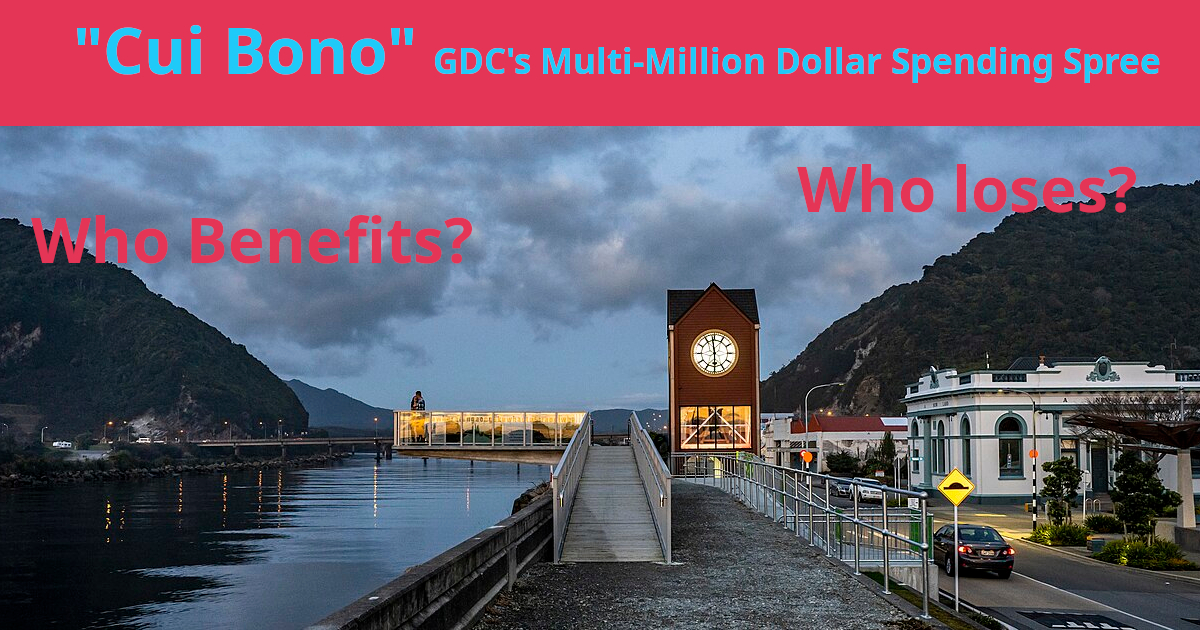
“Cui bono?”—To whom is it a benefit? This ancient Latin phrase was famously coined by the Roman orator and statesman Marcus Tullius Cicero in 55 BC. In his speech In Pisonem, Cicero used this rhetorical question to cut through legal mumbo-jumbo, arguing that if you want to understand the true purpose of an action, look at who stands to gain from it. It is a timeless tool for political analysis: follow the money, and you will often find the motive.
Applying Cicero’s logic to local government in the Grey District reveals a compelling narrative of wealth transfer. Over the past seven years, Grey District Council’s expenditure has surged from $28.5 million in 2018 to $48.3 million in 2025. That is a staggering 69% increase in public spending, funded largely through rates and borrowing. One cannot help but ask: who is really profiting from this massive redistribution of wealth?
GDC financial reports paint a clear picture. In the 2022/2023 financial year alone, actual expenditure hit $41.3 million against a budgeted $33.4 million—a $7.8 million unfavourable variance. Nearly two-thirds of that overrun ($5.4 million) was driven by soaring costs for consultants, contractors, and professional fees.
In recent years revenue from community facilities—such as the Grey Aquatic Centre and Westland Recreation Centre—have been significantly lower than budgeted. The Council has to find ways to plug the gap. They did so by increasing depreciation expenses. This reliance on accounting adjustments rather than genuine revenue growth has only intensified over time. By the 2022/2023 financial year, depreciation expenses had ballooned by more than $2.5 million following a massive revaluation of infrastructure assets. While these revaluations add millions to the Council’s balance sheet—pushing fixed assets to $556 million—they do not generate cash flow. Instead, they inflate the asset base, often justifying further borrowing or rate increases without providing tangible benefits to the residents paying for them.
This dynamic has created what economists might call a reverse Robin Hood effect: taking from the poor to feather the rich. Grey District ratepayers include pensioners on fixed incomes, young families stretching their budgets, and small business owners operating on thin margins. Whilst these hard-working ratepayers are suffering, consultants, engineers, and building merchandisers are cashing in on council contracts, riding the wave of a $41.3 million expenditure bill in 2022/23, $46.3 million in 2023/24 and $48.3 million in 2024/25. The wealth isn’t always being reinvested into the community; it’s circulating through a pipeline of private contractors and professional firms, leaving ratepayers with higher rates, longer wait times for consents, and a district plan review that remains “on hold indefinitely”.
One industry that stands to benefit from this trend is the construction and consulting sector. Data reveals that consultants, builders, and construction merchants have seen significant increases in their share of council expenditure over the past few years. The 2023 Annual Report shows that in 2022-23, payments to staff and suppliers in these industries totaled $24.1 million. By 2023-24, this figure had risen to $31.6 million, representing a remarkable growth rate of over 30%.
So, cui bono? The answer is clear. Grey District Council’s expenditure surge hasn’t been driven by necessity alone—it has been fuelled by a development model that externalises costs onto the public while privatising gains. As we move toward 2027 and beyond, the council must ask whether its spending strategy truly serves the community or simply subsidises an already lucrative contracting and consulting industry. Until cost recovery rates improve, professional fees are capped, and asset revaluations translate into tangible rate relief, the reverse Robin Hood effect will continue unabated. Ratepayers deserve more than accounting gymnastics; they deserve a council that spends wisely, charges fairly, and ensures that when public money flows out, real value flows back in. Until then, cui bono (Who Benefits) remains an open question—and the consultants and contractors are already writing the answer.
Note: The data provided in this response is based on material made publicly available by GDC. However, it’s essential to note that these figures may not be entirely up-to-date or accurate, as they are subject to change and might not reflect the current financial situation of GDC.
```js client
If you wish to post anonymously there is no need to fill in the email field.
If you have trouble posting a comment please use a chrome browser. Comments may not work with Firefox or other browsers, we are working to rectify this.